Most parents book a podiatry appointment when something hurts. But for children, the more important visits often happen before pain is even part of the picture. A child’s feet are not just smaller versions of adult feet. They grow, remodel, and adapt at a pace that adult feet do not, and the patterns set during those early years have a way of sticking around. If your child trips more than their friends, complains of sore legs after sport, or walks on their toes, a children’s foot assessment can clarify whether you are watching normal development or something worth addressing.
How children’s feet actually develop
At birth, the foot is mostly cartilage. The 28 bones that form the adult foot do not finish hardening until late adolescence, which means there is a long window during which loading, footwear, and movement patterns can shape how the foot ends up. The arch, for instance, is generally flat in toddlers because the fat pad under the foot has not yet thinned out. Most children develop a visible arch by around six years of age, though the timing varies.
Growth spurts add another layer of complexity. When bones lengthen quickly, the surrounding tendons and muscles do not always keep pace. This mismatch is the reason certain conditions cluster around peak growth periods. The heel bone is particularly vulnerable; it has a growth plate at the back that acts as the attachment point for the Achilles tendon, and rapid bone growth can create significant tension there.
None of this is cause for alarm. Most children navigate these phases without lasting difficulty. The reason podiatric assessment is useful is that it distinguishes between variation that resolves on its own and patterns that benefit from early intervention.
Common foot and lower limb conditions in children
Sever’s disease (calcaneal apophysitis)
This is the most common cause of heel pain in children aged 8 to 14, and it is seen far more often in active kids. The condition involves inflammation at the growth plate of the heel bone, typically triggered when the Achilles tendon pulls hard on a heel that is growing faster than the tendon can accommodate. Children often describe the pain as worsening during or after sport, and many start walking on their toes to offload the heel. Read more about Sever’s disease and what the assessment and management process looks like at The Heel Centre.
Management usually involves load modification, appropriate footwear, stretching of the calf and Achilles, and sometimes heel raises or custom orthotics to reduce tension at the growth plate. Complete rest is not generally recommended; activity modification is.
Flat feet (pes planus)
Flat feet in children are common and, in most cases, painless. There is a meaningful difference between flexible flat feet, where an arch forms when the child stands on tiptoe, and rigid flat feet, where the arch is absent regardless of position. Rigid flat feet, or flat feet associated with pain, fatigue in the legs, or altered gait, warrant assessment.
A podiatrist can evaluate whether the structure is contributing to any downstream issues in the knees, hips, or lower back, and advise on footwear and orthotic support where needed.
In-toeing and out-toeing
These gait patterns cause a lot of parental concern, and understandably so. A child who walks with their feet pointing inward or outward looks different from their peers, and parents often worry about long-term effects. Most cases of in-toeing resolve without treatment by the time a child reaches school age.
Out-toeing is less common and resolves more slowly. The key question is whether the rotation is coming from the foot itself, the shin bone, or the hip. A gait assessment can identify the source and determine whether intervention is needed or watchful waiting is appropriate.
Osgood-Schlatter disease
This condition affects the knee rather than the foot, but it belongs in any discussion of childhood musculoskeletal health. It involves pain and swelling just below the kneecap, at the point where the patellar tendon attaches to the tibia. Like Sever’s disease, it is a growth plate issue tied to rapid bone growth and high activity levels. Children in running and jumping sports are most affected, typically between ages 9 and 14.
Management focuses on load management, quadriceps strengthening, and in some cases taping or orthotics to offload the affected area.
Toe walking
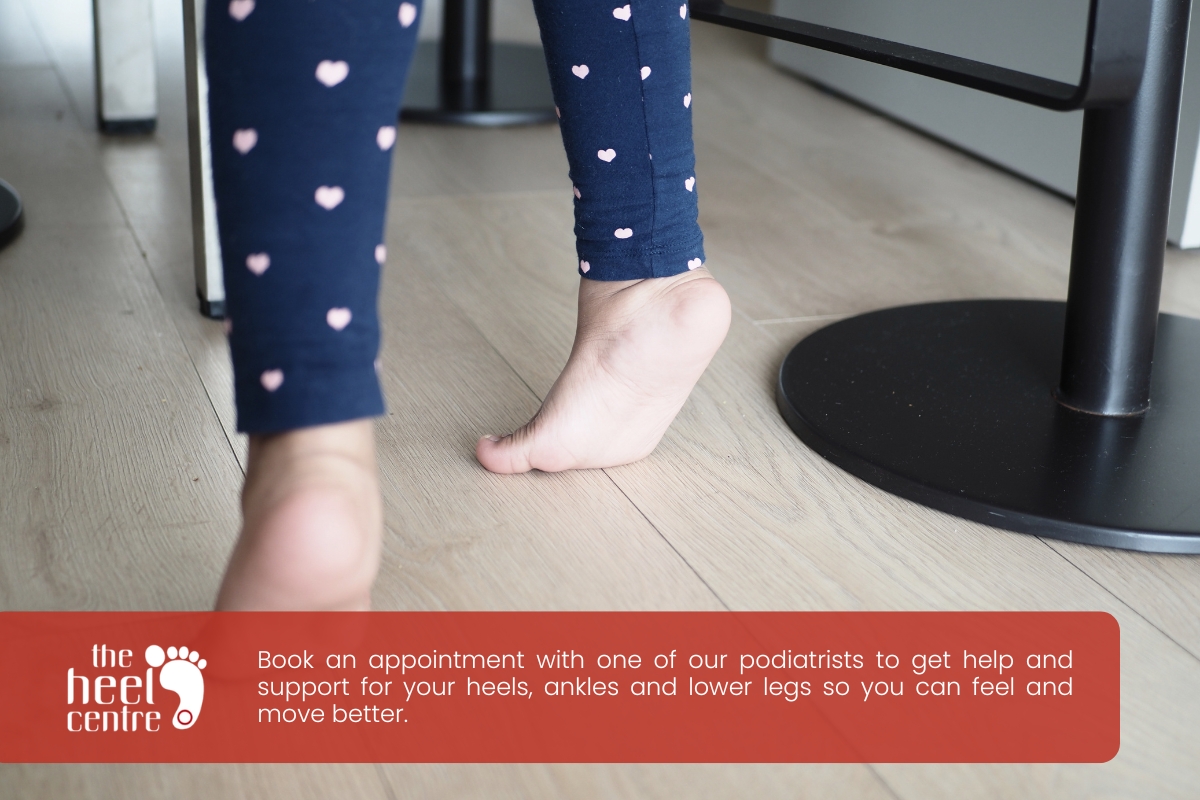
Habitual toe walking beyond the age of 3 is worth discussing with a podiatrist. Some children continue walking on their toes out of habit, and for many there is no underlying cause. Others have tightness in the calf or Achilles that perpetuates the pattern, and a smaller subset may have neurological or sensory processing differences that a broader team needs to assess.
A podiatrist can evaluate range of motion at the ankle, observe gait, and refer on if the clinical picture suggests a cause beyond habit.
When should you bring your child in?
There is no age that is too young for a foot assessment. It is worth booking an appointment if your child:
- complains of foot, heel, or leg pain that does not settle after rest
- walks on their toes past the age of 3
- trips or falls more than other children their age
- avoids physical activity or tires quickly during sport
- has noticeably asymmetrical feet, legs, or walking pattern
- wears shoes unevenly or through unusual parts of the sole
Teachers sometimes notice gait concerns before parents do, particularly during PE. If a teacher has flagged something, it is worth following up.
What a children’s foot assessment involves
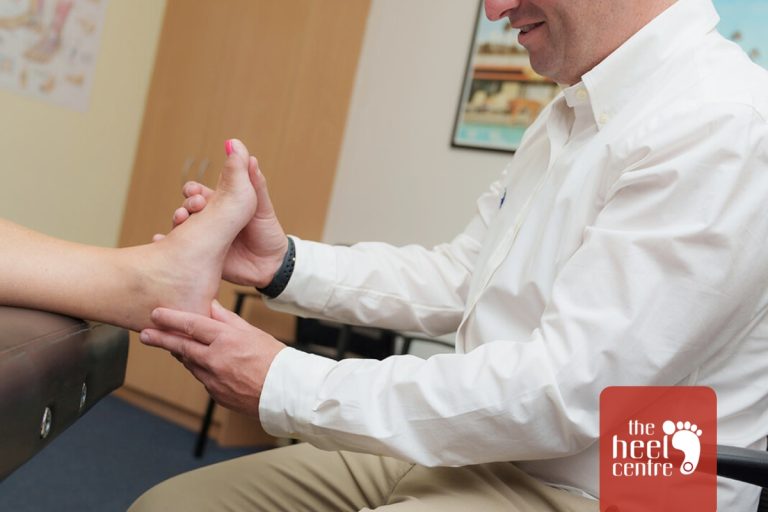
At The Heel Centre, a children’s foot assessment covers the structure and alignment of the foot and ankle, flexibility and range of motion, walking and sometimes running gait using video analysis, footwear review, and discussion of activity levels and any symptoms. The process is non-invasive and child-friendly. The outcome is a clear picture of whether development is on track and, where it is not, a practical management plan.
For many families, the appointment provides reassurance. For those where something does need attention, early detection means simpler interventions and better long-term outcomes.
When podiatry is not the first step
Some presentations in children point toward other disciplines first. Pain following a fall or sports injury should have a GP or orthopaedic review to rule out fracture before a podiatry assessment. Neurological concerns, significant motor delays, or signs of muscle weakness beyond what gait analysis can explain are best assessed initially by a paediatrician or paediatric neurologist. Podiatry works well alongside these pathways, not instead of them.
Children’s foot health: Your Questions Answered
| Question | Answer |
|---|---|
| At what age should my child see a children’s podiatrist? | There is no minimum age for a children’s foot assessment. A first visit is useful around age 3 to establish a baseline, or at any point where you notice pain, unusual gait, or foot shape concerns. Early assessment means more options if intervention is needed. |
| Is flat feet in children something to worry about? | Most toddlers have flat feet, and the arch typically develops by around age 6. If flat feet persist, cause pain, or are rigid (no arch on tiptoe), a podiatry assessment can determine whether footwear or orthotic support is appropriate. |
| What is Sever’s disease and how is it treated? | Sever’s disease is the most common cause of kids’ heel pain, affecting children aged 8 to 14 during growth spurts. The growth plate in the heel becomes inflamed as the bone grows faster than surrounding tendons. Treatment involves load management, stretching, footwear changes, and sometimes orthotics. |
| My child walks on their toes. Should I be concerned? | Toe walking is common in children under 3. If it persists beyond that age, a podiatrist can assess ankle range of motion and gait to determine whether the cause is habit, calf tightness, or something requiring referral to another specialist. |
| Can a podiatrist help with in-toeing in children? | Yes. A podiatrist can assess where the in-toeing originates (foot, shin, or hip) and advise on whether it is likely to resolve naturally or benefit from intervention. Most cases of in-toeing resolve without treatment by school age. |
| What does a children’s foot assessment at The Heel Centre include? | Assessments cover foot and ankle structure, flexibility, gait observation (sometimes with video analysis), footwear review, and symptom history. The process is non-invasive and suited to children of all ages. You will leave with a clear picture of your child’s foot health and any recommended next steps. |
Final thoughts
Children’s feet are adaptable, and most developmental variations sort themselves out. For the ones that do not, the earlier an assessment happens, the more options are available. A podiatrist can distinguish between a pattern that needs monitoring, one that needs intervention now, and one that was never going to cause a problem.
If something about your child’s gait or foot health has been on your mind, an assessment is the most efficient way to get a clear answer.
Book a children’s foot assessment at The Heel Centre across our clinics in Ringwood East, Frankston, and Caulfield North. Book online here or call your nearest clinic.